
Criminal Court Records in Woods County
A criminal court record is the case file a court opens once the State files charges. It is more than an arrest report. It is the running history of a prosecution. The Woods County Court Clerk keeps these files for the district court in Alva. Each Woods County case gets a number, a caption, and a docket. The docket lists every filing, hearing, and order in date order. Booking detail and the jail roster live elsewhere, so they sit apart from the case file that the court builds.
The Woods County District Court hears all criminal matters in the county. Cases split by grade. Felony cases carry the prefix CF and cover the most serious crimes. Misdemeanor cases carry the prefix CM and cover lower-grade offenses. Both run through the same Woods County courthouse and the same clerk. The District Attorney for District 26 files and prosecutes these charges for the State of Oklahoma. That office sits in the same courthouse as the court.
The Oklahoma District Attorneys Council lists the prosecutors who bring criminal charges across the state. You can view the statewide district attorney directory to see how the offices are organized.
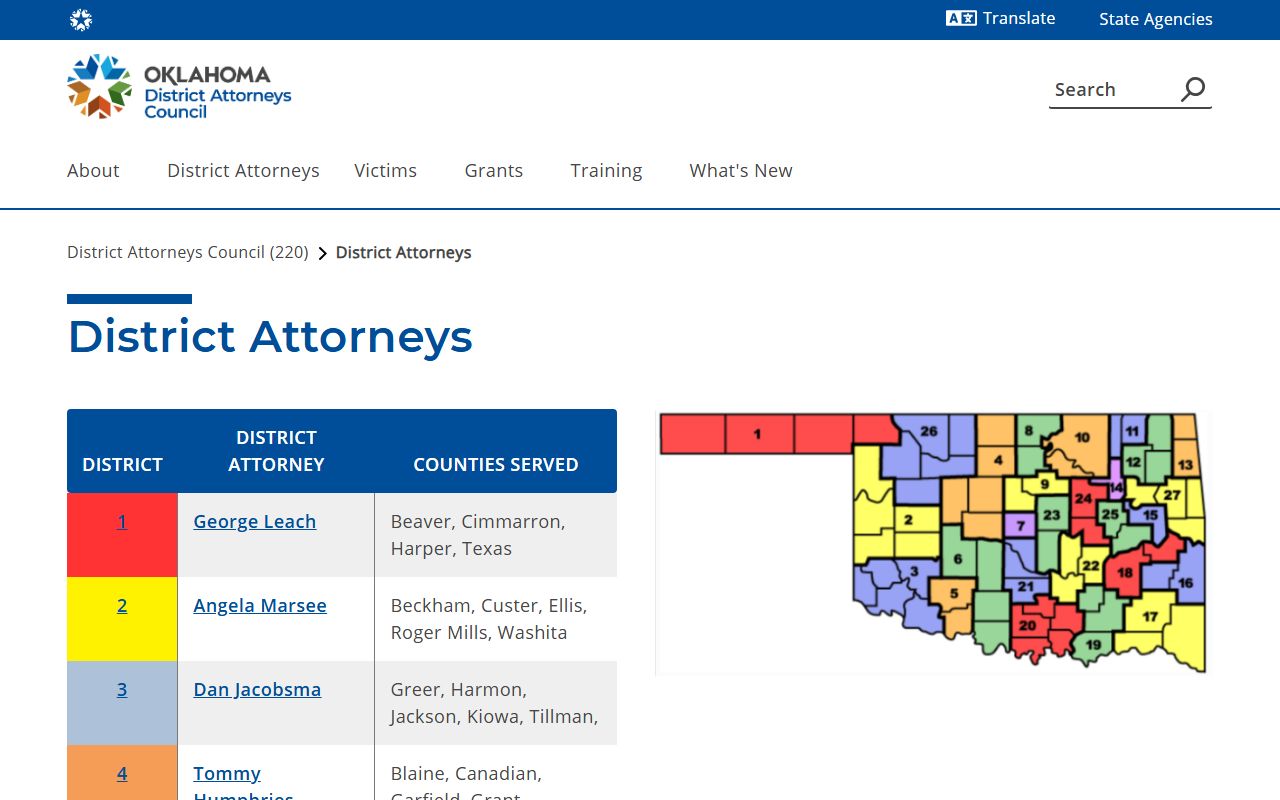
District 26 covers Woods County along with four neighbors. The prosecutor there decides what to charge and what to file in the district court, which is where the criminal court record begins.
How to Search Woods County Criminal Court Records
Most Woods County criminal cases can be searched online for free. On Demand Court Records, known as ODCR, lists Woods County as an Oklahoma District Court option. The Oklahoma State Courts Network, or OSCN, offers a second official docket channel. Both let you look up a case by name or case number. For a certified copy of a Woods County criminal case, the Court Clerk is the official source.
- Open ODCR and set the court group to Oklahoma District Courts, then choose Woods as the court.
- Enter the defendant name as "Last, First," or type a known case number such as CF-2022-00017.
- Narrow the results by case type and filed-date range if the name returns too many hits.
- Open the case to read the docket, the charges, and the disposition.
- Request a certified copy from the Court Clerk when you need an official version for legal use.
OSCN runs a parallel system at the state court docket site. That page may ask for browser verification before it loads. If it blocks you, try again in a standard browser or call the Court Clerk. The broader set of Woods County court records covers civil, family, and probate files through the same portals.
Stages of a Woods County Criminal Case
A Woods County criminal case moves through clear stages. Each one leaves a mark on the record. The docket entries follow the same order, so reading them tells you where a case stands. Felony cases add a preliminary hearing that misdemeanors skip.
Case flow: Charges Filed › Arraignment › Pretrial / Motions › Plea or Trial › Disposition › Sentencing
| Stage | What Happens |
|---|---|
| Arraignment | The court reads the charges, sets bond, and takes a first plea. Counsel is named here if the defendant qualifies. |
| Pretrial / Motions | Lawyers file motions, exchange evidence, and argue legal issues. The docket logs each motion and order. |
| Plea or Trial | The case ends in a plea or goes to trial. A jury or judge then decides guilt. |
| Sentencing | The judge sets the penalty. The record notes fines, costs, jail or prison time, and probation terms. |
A defendant who cannot afford a lawyer may get appointed counsel. The Oklahoma Indigent Defense System, or OIDS, covers Woods County criminal cases through its non-capital trial office in Woodward. You can review the OIDS Woods County coverage page to see how that office is assigned.
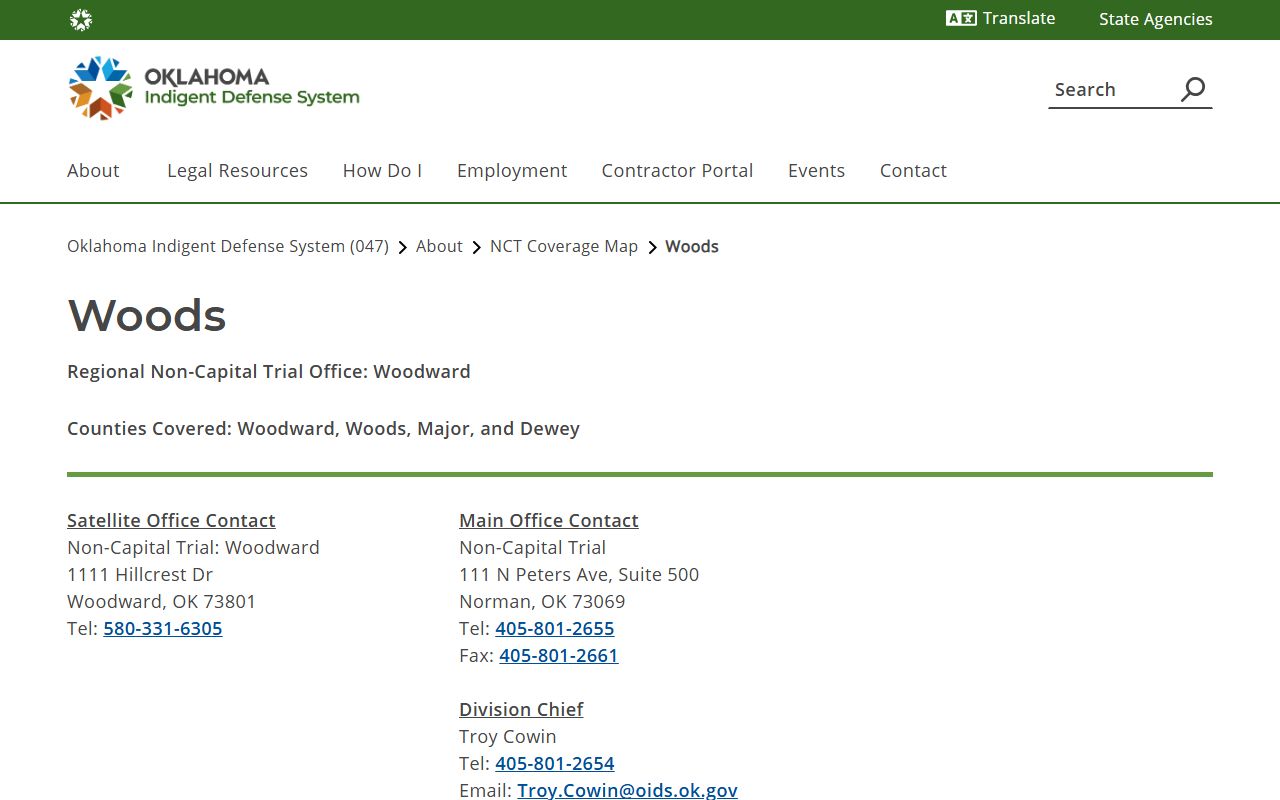
When OIDS appoints a lawyer, that entry shows on the docket. The record then names defense counsel alongside the prosecutor for the rest of the case.
What a Woods County Criminal Court Record Shows
A Woods County criminal case file packs a lot of detail into a set of standard fields. Public dockets on ODCR and OSCN show most of them. Document images often sit behind a paid account, but the docket text is broad. The table below maps the main fields to what each one tells you.
| Field | What It Shows |
|---|---|
| Case Number | The prefix, year, and sequence, such as CF-2022-00017 for a felony or a CM number for a misdemeanor. |
| Defendant | The person charged, listed in the caption as State of Oklahoma versus the named defendant. |
| Charges | The offense or cause text, such as the crime charged and its grade. |
| Plea | The defendant's formal answer, such as guilty, not guilty, or no contest. |
| Disposition | The outcome, such as a conviction, a dismissal, or a deferred result. |
| Sentence | The penalty, including jail or prison time, probation, fines, and court costs. |
The Woods County docket also lists the judge, the district attorney, and defense counsel. Calendar events show hearing dates and whether each was completed. Financial entries break out line items like the court fund fine, the law library fee, the sheriff fee, AFIS, CLEET, the DPS assessment, the DA revolving fund, the OCIS fee, and victim services. Receipts log each payment by date and amount.
Charges vs. Convictions
Being charged is not the same as being convicted. A charge is an accusation. A conviction is a final finding of guilt. A Woods County criminal court record can show charges that were dropped, dismissed, or ended in acquittal. Reading the disposition is the only way to know the result. The charge text alone never tells the full story.
| Charge | Conviction | |
|---|---|---|
| Stage | Accusation | Verdict or plea |
| Burden of Proof | Probable cause | Beyond reasonable doubt |
| Public Record | Yes | Yes |
The charges side of the file gets a closer look on the Woods County court charge records page. That page tracks how a charge can be amended, reduced, or dismissed before a case ends. Note: a dismissed or acquitted charge still appears in the public docket unless a court later seals or expunges it.
Reading Woods County Dispositions and Sentences
The disposition is the result of a Woods County case. Common entries include guilty, not guilty, dismissed, and nolo contendere, which means no contest. Some cases end in a deferred or suspended sentence, where penalties hold off if the defendant meets conditions. A revocation entry means the court was asked to undo a deferred or suspended term. Each one carries a different long-term effect.
The sentence sits next to the disposition. It can list jail or prison time, probation, fines, and the line-item court costs. A Rule 8 payment plan often appears when a defendant cannot pay all costs at once. Defense counsel shapes much of this stage, and OIDS represents qualifying defendants across the state through trial and sentencing. The Oklahoma Indigent Defense System explains that statewide role.
Sentencing entries are where the record gets practical. They show what a defendant owes, what time was imposed, and whether probation applies.
Sealed vs. Expunged Records
Oklahoma lets some people seal or expunge a Woods County criminal record. The two are not the same. A sealed record is hidden from general public view but still exists. An expunged record is treated as if it never happened. Both need a court order. Eligibility turns on the charge, the disposition, the waiting period, and any prior record.
| Sealed | Expunged | |
|---|---|---|
| Visibility | Hidden from public | Destroyed / treated as never existed |
| Law Enforcement | Limited access | Very limited |
| Eligibility | Set by 22 O.S. order by charge and disposition | Set by 22 O.S. waiting period and prior record |
A person files a petition in the Woods County District Court, serves the agencies that hold the records, and obtains a signed order if eligible. The Court Clerk can confirm filing steps and fees, but legal advice needs an attorney. The expungement and sealing rules sit in Title 22 of the state code. You can read the Oklahoma criminal procedure statutes that govern the process.
Those statutes set out who qualifies and how the order must list each agency and record. Once entered, the clerk and the agencies apply the order to public access.
Public Access to Woods County Criminal Records
Oklahoma treats most Woods County court records as open to the public. The default is access, with named exceptions for sealed, juvenile, and sensitive files. Two bodies of law shape what you can see. One opens public-body records in general. The other governs how criminal records get sealed or expunged. Public docket pages are useful, but they are not the official certified record.
Key Statutes:
Oklahoma Code § 51 O.S. 24A.1 et seq. - The Open Records Act makes public-body records open unless a specific law makes them confidential.
Oklahoma Code § 22 O.S. 18 and 19 - These sections set the eligibility and the court-order process for sealing or expunging a criminal record.
Background Check Considerations
A casual case lookup is not a background check. Formal background screening for jobs, housing, or credit falls under federal law and follows strict rules. A Woods County docket search shows what the court filed, but it may miss sealed or out-of-county matters. For a legal-use copy, request a certified record from the Court Clerk. For employment or tenant screening, use a provider that follows federal screening law.
Important: This site is not a consumer reporting agency under the Fair Credit Reporting Act, and its records may not be used for credit, employment, tenant, or insurance decisions.
Restricted Criminal Court Records in Woods County
Not every Woods County criminal matter is open. Some files are closed by law. Juvenile cases are not ordinary public records, and access is limited to parties, attorneys, agencies, or a court order. Sealed and expunged cases may return no result or only a status line. Adoption and mental health proceedings stay confidential.
Personal identifiers are also withheld. Court rules require filers to protect Social Security numbers, financial account numbers, and similar data. Victim and minor information in sensitive cases can be redacted as well. When a case involves an active warrant, some entries may stay limited until the warrant is served. When access is unclear, the Court Clerk can confirm what part of a file is public.